Tel:+86-027-59403931 Ext 8009
 Email: wwqin@oryzogen.com
 Contact Us
 Inquiry Now









Rice-Derived Recombinant Albumin vs. Yeast-Expressed HSA: Pros and Cons for Bioprocessing
Release time: 2026-11-02
Table of Contents
Recombinant human serum albumin (rHSA) is an important protein in pharmaceutical manufacturing, cell culture, and bioprocess development. As demand for alternatives to plasma-derived proteins increases, manufacturers are exploring different expression systems to produce human albumin with consistent quality and reliable supply.
Rice-based and yeast-based expression systems are two approaches used in recombinant protein production. Both offer alternatives to conventional plasma fractionation, but they involve different biological hosts, production processes, recovery strategies, and impurity profiles.
For biopharmaceutical manufacturers, choosing between rice-derived recombinant albumin and yeast-expressed human serum albumin is not simply a question of which expression system produces more protein. The decision should consider protein folding, product quality, purification requirements, manufacturing scalability, and suitability for the intended application.
This comparison examines the technical advantages and limitations of both platforms and explains what buyers should evaluate when selecting recombinant albumin for bioprocessing.
1. Understanding the Two Recombinant Albumin Expression Systems
Human serum albumin is a single-chain protein consisting of 585 amino acids, with a molecular weight of approximately 66.5 kDa. Its structure contains 17 disulfide bonds and one free cysteine residue, Cys34, which contributes to several of its biochemical properties.
Because albumin has a relatively complex three-dimensional structure, its production requires appropriate control of protein folding, oxidation state, and purification.
Rice-Derived Recombinant Human Albumin
Rice-based expression uses plant biological systems to produce recombinant human albumin. Depending on the production platform, the protein may accumulate in plant tissues or specific cellular compartments before being recovered and purified.
One potential advantage of this approach is the ability to use plant-based production infrastructure rather than human plasma or microbial fermentation as the starting production platform.
However, plant-derived recombinant proteins require careful control of host-derived impurities, including residual plant proteins and other process-related substances.
The extraction and purification process is particularly important because the target protein must be separated from the complex biological components of the plant production material.
Yeast-Expressed Human Serum Albumin
Yeast expression systems, including Saccharomyces cerevisiae and Komagataella phaffii (formerly Pichia pastoris), are widely used in recombinant protein manufacturing.
Depending on the expression design, recombinant albumin can be produced intracellularly or secreted into the culture medium.
Secretion can simplify certain aspects of product recovery by separating the target protein from much of the cellular biomass. However, this does not eliminate the need for purification. Residual host-cell proteins, nucleic acids, media components, and other process-related impurities still require appropriate control.
Yeast-based manufacturing also requires attention to fermentation conditions, oxygen transfer, nutrient supply, proteolytic activity, and expression stability.
2. Protein Folding and Structural Integrity: A Critical Comparison
One of the most important considerations in recombinant albumin production is achieving the correct protein structure.
Albumin’s biological and physicochemical properties depend on its native conformation. Incorrect folding, incomplete disulfide bond formation, or oxidation-related changes may affect its binding behavior and stability.
Challenges in Yeast Expression
Yeast cells provide cellular machinery that can support recombinant protein production and, in suitable expression designs, secretion.
However, high expression levels do not necessarily translate into high-quality functional protein.
Potential challenges include:
- Incorrect or incomplete disulfide bond formation.
- Proteolytic degradation during expression or secretion.
- Intracellular retention or inefficient secretion.
- Formation of incorrectly folded protein species.
- Variations in product quality under different fermentation conditions.
The secretion pathway may help with protein recovery, but its efficiency and effect on product quality depend on the expression construct and host strain.
Considerations in Rice-Based Expression
Plant-based expression systems also require precise control of protein folding and structural integrity.
The intracellular environment, protein accumulation location, and downstream extraction conditions can influence the recovery of correctly folded albumin.
Potential challenges include:
- Maintaining protein integrity during extraction.
- Controlling plant-derived host-cell impurities.
- Preventing aggregation during recovery and purification.
- Achieving consistent product quality across production batches.
Neither system should be assumed to produce correctly folded albumin simply because the target protein is expressed successfully.
Manufacturers should evaluate structural integrity using appropriate analytical methods, including peptide mapping, electrophoretic analysis, and other product-specific characterization techniques.
3. Glycosylation: Why It Should Not Be the Main Selection Criterion
Glycosylation is frequently discussed when comparing plant and yeast expression platforms. However, it is important to understand the specific characteristics of the target protein.
Native human serum albumin is a non-glycosylated protein. Therefore, the presence of different glycosylation pathways in rice and yeast does not automatically make one expression system more suitable for producing HSA.
For albumin, more relevant quality considerations include:
- Amino acid sequence identity.
- Correct disulfide bond formation.
- Protein conformation and structural integrity.
- Oxidation and degradation profiles.
- Aggregate content.
- Residual host-cell proteins and other impurities.
The expression host can still influence the final product through its cellular environment and manufacturing process. However, these effects should be evaluated through product characterization rather than generalized assumptions about plant or yeast glycosylation.
This distinction is important for buyers comparing different recombinant albumin suppliers.
4. Downstream Processing and Impurity Clearance
The expression system is only one part of recombinant albumin manufacturing. Downstream processing can significantly influence the final product’s quality, recovery, and manufacturing economics.
Rice-Based Production: Extraction and Plant Impurity Control
For rice-derived recombinant albumin, the purification process must recover the target protein from plant-derived production material.
Depending on the production design, downstream processing may involve extraction, clarification, filtration, and chromatographic purification.
A major consideration is the removal of plant-derived impurities.
These may include:
- Endogenous rice proteins.
- Residual nucleic acids.
- Other plant-derived macromolecules.
- Process-related impurities introduced during extraction and purification.
The efficiency of impurity clearance and the preservation of albumin integrity must be evaluated together.
Yeast-Based Production: Fermentation and Host-Related Impurities
Yeast production generally involves controlled cultivation and fermentation, followed by product recovery and purification.
When albumin is secreted into the culture medium, the recovery process may avoid some of the disruption associated with intracellular production.
Nevertheless, manufacturers must control potential impurities such as:
- Residual yeast host-cell proteins.
- Host-cell DNA.
- Proteolytic fragments.
- Residual fermentation components.
- Other process-related contaminants.
The purification strategy must be designed around the specific host, expression system, and product quality requirements.
Which System Has an Easier Purification Process?
There is no universal answer.
A secreted yeast protein may offer recovery advantages in some manufacturing configurations, while a rice-based process may have different extraction and purification requirements.
Actual purification efficiency depends on expression levels, target protein location, impurity composition, process design, and the required final specifications.
A fair comparison should therefore consider total downstream recovery, impurity clearance, product integrity, and process consistency rather than looking at one purification step in isolation.
5. Manufacturing Scalability and Production Economics
For biopharmaceutical manufacturers, scalability is an important consideration when selecting a recombinant protein supplier.
However, the production economics of rice and yeast systems cannot be compared using expression host alone.
Yeast Fermentation
Yeast fermentation benefits from established microbial manufacturing infrastructure and well-developed process control technologies.
Important parameters include:
- Fermentation vessel capacity.
- Oxygen transfer and mixing.
- Nutrient feeding strategy.
- Temperature and pH control.
- Cell growth and expression performance.
- Batch consistency and product recovery.
One potential advantage is the availability of established fermentation technologies. Nevertheless, high-density cultivation and recombinant protein secretion require careful process optimization.
Rice-Based Production
Rice-based production uses plant cultivation and plant-based expression infrastructure.
Its manufacturing considerations may include:
- Consistency of biological starting material.
- Control of growing and production conditions.
- Target protein accumulation.
- Harvesting and extraction efficiency.
- Purification capacity.
- Long-term production planning.
The production economics depend on the expression platform, facility design, extraction efficiency, purification requirements, and manufacturing scale.
It would therefore be inaccurate to claim that rice-based production is always cheaper or that yeast fermentation is always easier to scale.
For buyers, the more useful comparison is the supplier’s demonstrated production consistency, available capacity, batch release controls, and ability to maintain quality during scale-up.
6. Quality Control: What Should Buyers Compare?
When sourcing recombinant albumin, buyers should focus on the final product’s quality attributes rather than relying exclusively on the expression host.
A structured evaluation can include the following categories.
| Quality attribute | Why it matters |
|---|---|
| Protein identity | Confirms the target protein sequence and identity |
| Purity | Evaluates the proportion of target protein and other protein-related impurities |
| Aggregate content | Helps assess protein quality and stability |
| Structural integrity | Supports evaluation of correct folding and molecular characteristics |
| Oxidation profile | Helps characterize changes in albumin, including oxidation-sensitive residues |
| Endotoxin | Relevant to biological and pharmaceutical applications |
| Host-cell impurities | Assesses residual proteins and nucleic acids from the production system |
| Stability | Evaluates product behavior during storage and handling |
The specific analytical methods and acceptance criteria should be established according to the intended application and applicable quality requirements.
For pharmaceutical manufacturing, additional assessments may be required depending on the material’s regulatory status and intended use.
7. How to Choose Between Rice-Derived and Yeast-Expressed Albumin
The appropriate expression platform depends on the manufacturer’s priorities and the quality of the available product.
Rice-derived recombinant albumin may be worth evaluating when:
- The manufacturer wants an alternative to plasma-derived and microbial production routes.
- A plant-based recombinant production platform fits its sourcing strategy.
- The supplier can demonstrate appropriate purification and impurity control.
- The final material meets the required structural and functional specifications.
Yeast-expressed albumin may be worth evaluating when:
- Established microbial fermentation infrastructure is an important consideration.
- A secretion-based production strategy is suitable for the target process.
- The supplier can demonstrate effective control of host-cell impurities.
- Manufacturing capacity and fermentation consistency meet supply requirements.
Neither platform is automatically superior. A manufacturer should compare the actual quality specifications, batch performance, supply reliability, and application compatibility of the products being considered.
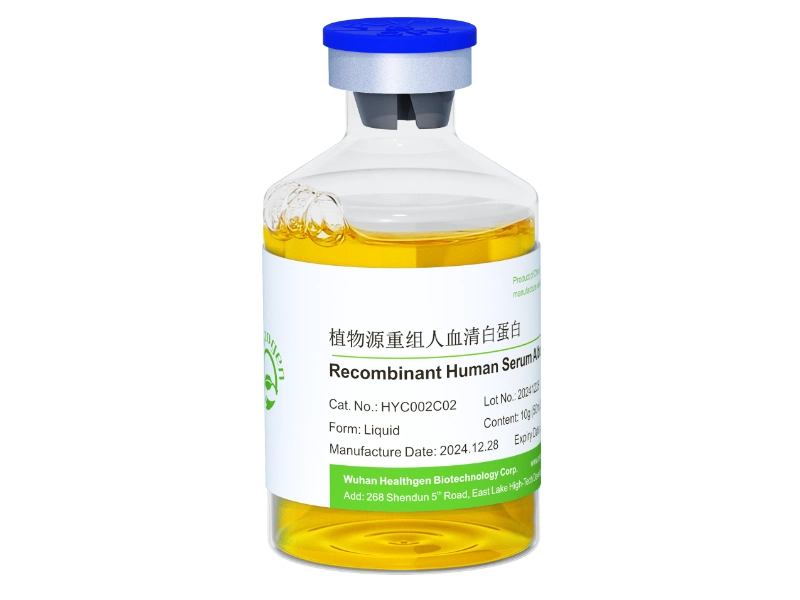
For companies sourcing liquid recombinant human albumin, it is also important to review formulation composition, concentration, storage conditions, and intended application rather than treating liquid presentation as evidence of higher purity or better performance.
8. The Role of Rice-Derived Albumin in Recombinant Protein Manufacturing
The development of alternative recombinant expression platforms reflects a broader shift toward diversified sourcing and more defined raw materials in biopharmaceutical manufacturing.
Rice-derived recombinant human albumin provides a plant-based production option for manufacturers evaluating alternatives to conventional plasma-derived materials and microbial expression systems.
Healthgen Biotech develops plant-derived recombinant proteins, including recombinant human albumin. Its product portfolio offers an option for researchers and manufacturers evaluating rice-based recombinant protein production.
For bioprocess developers, the key decision should remain grounded in product-specific evidence: structural integrity, purity, impurity clearance, stability, batch consistency, and suitability for the intended manufacturing application.
Frequently Asked Questions
1. Is rice-derived recombinant human albumin better than yeast-expressed HSA?
Not necessarily. Both systems have potential advantages and manufacturing challenges. Rice-based production involves plant material extraction and plant-derived impurity control, while yeast production involves fermentation management and yeast-related impurity clearance. The better choice depends on final product quality and application requirements.
2. Does yeast expression cause glycosylation of recombinant human albumin?
Native human serum albumin is non-glycosylated. Therefore, glycosylation should not be treated as the primary differentiating factor between rice and yeast expression systems for HSA. Structural integrity, disulfide bond formation, oxidation, aggregation, and residual host-related impurities are more relevant evaluation points.
3. Which analytical tests are important when comparing rice-derived and yeast-derived HSA?
Relevant tests include protein identity, purity, aggregate content, structural characterization, oxidation profile, endotoxin, and residual host-cell impurities. Stability and functional evaluations should also be considered according to the intended application.
4. Can expression system alone determine the manufacturing cost of recombinant albumin?
No. Production economics depend on expression yield, upstream process efficiency, recovery, purification requirements, facility infrastructure, quality control, and manufacturing scale. A meaningful cost comparison should consider the total cost of producing material that meets the required specifications.