Tel:+86-027-59403931 Ext 8009
 Email: wwqin@oryzogen.com
 Contact Us
 Inquiry Now









Why Biotech Startups Prefer Rice-Derived Olbumin® for Preclinical Biologic Studies
Release time: 2026-10-30
Table of Contents
For biotech startups developing biologics, preclinical research is an important stage for evaluating formulation feasibility, protein stability, biological activity, and potential safety concerns before moving toward more advanced development. At this stage, the selection of raw materials can influence experimental reproducibility and the interpretation of study results.
Human serum albumin (HSA) is widely used in pharmaceutical and biotechnology applications because of its ability to bind various molecules, interact with biological components, and contribute to protein stabilization in suitable formulations. However, the source and quality of albumin also deserve attention, particularly when startups are developing defined formulations or seeking to reduce reliance on human plasma-derived materials.
Rice-derived recombinant human serum albumin, represented by Olbumin®, offers an alternative sourcing approach. Its plant-based expression origin makes it relevant to companies evaluating recombinant proteins for preclinical biologic studies.
Why are more biotechnology developers considering this type of raw material, and what should they evaluate before selecting it?
1. Why Raw Material Selection Matters in Preclinical Biologic Studies
Preclinical studies involve multiple experiments designed to evaluate the properties and performance of a biological candidate. These may include formulation screening, protein stability assessment, compatibility studies, and preliminary biological evaluations.
Although the therapeutic candidate receives most of the attention, formulation components and processing materials can also influence experimental outcomes.
Albumin is frequently considered in biological formulations because it has several established physicochemical properties:
- It can bind a range of endogenous and exogenous molecules.
- It can contribute to protein stabilization in appropriate formulation systems.
- It may reduce nonspecific adsorption of certain proteins to surfaces.
- It can serve as a carrier protein in selected pharmaceutical applications.
However, these functions depend on the formulation environment, protein characteristics, and intended application. Albumin should not be assumed to improve every biologic formulation.
For startups working with limited development resources, selecting a well-characterized raw material early can help reduce unnecessary formulation changes and support more consistent experimental comparisons.
2. Why Consider Rice-Derived Recombinant Human Serum Albumin?
Traditional human serum albumin is commonly obtained from pooled human plasma. Although plasma-derived HSA has a long history of pharmaceutical use, its human biological origin requires appropriate donor screening, pathogen safety controls, and manufacturing oversight.
Rice-derived recombinant human serum albumin provides a different production approach.
Instead of relying on donated human plasma as the starting material, recombinant albumin is produced using a plant-based expression system. This changes the source-related risk profile and provides an alternative route for obtaining human albumin.
For biotechnology startups, several considerations make this approach relevant.
Reduced Dependence on Human Plasma
A plant-based recombinant production system does not require human plasma as its starting material.
This can be attractive to developers seeking to reduce dependence on plasma-derived raw materials and establish a more clearly defined sourcing strategy.
However, recombinant origin does not eliminate the need for quality control. Manufacturers still need to evaluate product identity, purity, aggregates, residual process-related impurities, endotoxin, and microbiological quality as appropriate for the intended application.
A Different Approach to Raw Material Traceability
The production process of recombinant proteins differs from plasma fractionation.
For preclinical development, understanding the expression system, purification process, manufacturing controls, and batch documentation can help researchers assess whether a material is suitable for their studies.
The relevant advantage is not simply that a protein comes from rice, but that its production and quality attributes can be evaluated through a defined manufacturing process.
Compatibility with Defined Formulation Development
Biologic formulations often require careful control of their components. Uncharacterized or variable raw materials can complicate the interpretation of stability and compatibility studies.
Rice-derived recombinant HSA may be considered when developers want to evaluate an alternative albumin source within a defined formulation strategy.
Its actual performance must still be confirmed using the intended biological molecule, concentration, buffer composition, and storage conditions.
3. How Albumin Supports Biologic Formulation Research
Albumin is not a universal stabilizer, but its molecular properties make it useful in several pharmaceutical formulation contexts.
For example, albumin can interact with hydrophobic compounds and other molecules through its binding sites. It can also influence protein behavior at interfaces and may help reduce certain forms of nonspecific surface adsorption.
These characteristics are relevant to different types of preclinical biologic studies.
Protein Stability Evaluation
Some therapeutic proteins are sensitive to environmental conditions, including temperature, pH, interfaces, and formulation composition.
Albumin may be investigated as a formulation component when researchers are evaluating protein stability or seeking to reduce nonspecific interactions.
Nevertheless, its effect must be demonstrated through appropriate analytical methods, such as protein aggregation analysis and stability-indicating assays.
Drug Delivery and Carrier-Related Research
Albumin has established relevance in drug delivery research because of its molecular binding properties and interactions with various compounds.
Researchers may investigate albumin-containing systems when studying the formulation behavior or delivery characteristics of selected biologic and pharmaceutical candidates.
The suitability of a particular albumin source depends on the drug molecule, delivery strategy, and intended route of administration.
Formulation Compatibility Studies
During preclinical development, startups may compare different formulation components to understand their influence on product stability and biological activity.
In this context, an albumin excipient for biologic formulations should be evaluated according to its intended function rather than selected solely because it is a recombinant protein.
Useful evaluation parameters include protein integrity, compatibility with other formulation components, aggregate formation, and the maintenance of biological activity.
4. What Should Startups Evaluate When Selecting Recombinant Albumin?
Choosing a recombinant albumin product requires more than checking whether it is plant-derived.
Different expression systems and purification processes can produce materials with different quality attributes. Startups should therefore review the product documentation and confirm its suitability for the specific preclinical application.
Product Identity and Purity
Confirm that the material is human serum albumin and review the supplier’s product-specific identity and purity information.
Purity alone is not sufficient to establish suitability, particularly when the protein will be used in sensitive biological experiments.
Aggregation and Structural Integrity
Albumin’s structural integrity is relevant to its functional behavior.
Researchers should review available information on aggregates and degradation products, especially when conducting protein stability or formulation compatibility studies.
Endotoxin and Microbiological Quality
The required endotoxin and microbiological specifications depend on the intended application.
For experiments involving sensitive biological systems, these attributes should be evaluated against the study’s requirements rather than assumed from the recombinant origin.
Formulation and Storage Conditions
Albumin products may be supplied in different physical forms, including liquid and powder formats.
The choice depends on laboratory handling requirements, preparation procedures, storage conditions, and the intended experimental workflow.
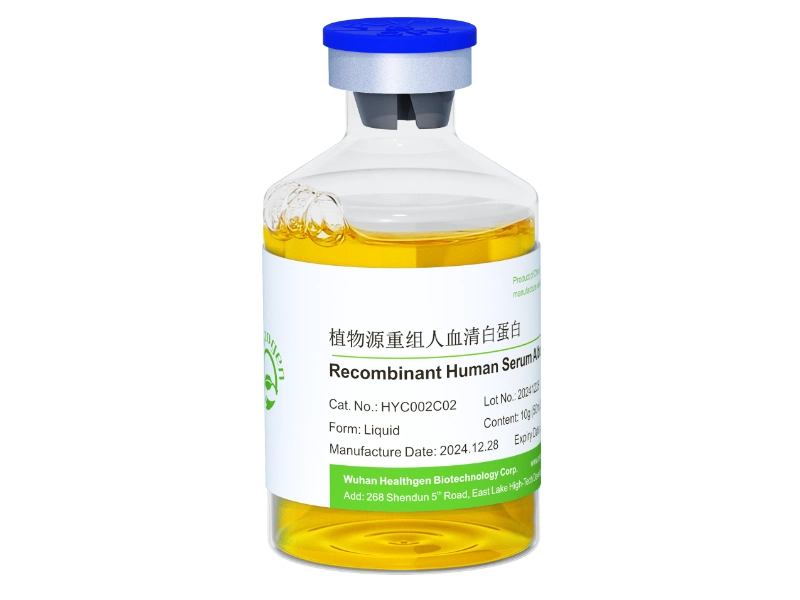
For example, researchers comparing a recombinant human albumin injection with a powder-format product should examine the respective product specifications, formulation, and intended application. The two formats should not be treated as interchangeable without reviewing their documentation.
5. Recombinant Albumin Injection vs. Powder: Which Format Should Startups Consider?
The physical format of an albumin product can affect preparation, storage, and experimental handling.
Liquid products may offer convenience when a ready-to-use formulation is appropriate. Powder products may provide flexibility for researchers who need to prepare working solutions according to their experimental protocols.
However, format selection should not be based on convenience alone.
Startups should consider:
- Whether the supplied formulation is compatible with the intended study.
- Whether additional preparation or dilution is required.
- Whether the product’s storage conditions fit laboratory requirements.
- Whether reconstitution and handling could introduce variability.
- Whether the available documentation supports the intended research application.
A recombinant human albumin powder may be worth considering when researchers require a powder-format raw material, while liquid products may be more convenient for workflows that favor a supplied solution.
Importantly, an injection-designated product and a research-use formulation should not automatically be considered equivalent. Buyers should confirm the intended use, product specifications, and applicable quality documentation before procurement.
6. Why Rice-Derived Albumin Is Relevant to Biotech Startups
Startups often face a different set of development challenges from established pharmaceutical manufacturers.
They may need to balance experimental reproducibility, raw material availability, development costs, and future process scalability while working with limited budgets and small research teams.
Rice-derived recombinant albumin may offer several considerations within this environment.
Alternative sourcing strategy: It provides an option that does not depend on human plasma as the starting material.
Defined production approach: Recombinant manufacturing allows the expression and purification processes to be evaluated through supplier documentation and quality controls.
Formulation development flexibility: Different albumin formats can be considered according to the needs of preclinical experiments.
Potential support for process development: Evaluating recombinant raw materials during early development may help teams assess whether the selected material is suitable for later formulation and manufacturing studies.
These considerations do not mean that rice-derived albumin is automatically superior to plasma-derived HSA. The appropriate choice depends on the product’s quality attributes, study objectives, and application-specific performance.
7. From Preclinical Research to More Consistent Biomanufacturing
A raw material selected during preclinical development may become part of the broader process development strategy if the formulation advances.
For this reason, startups should consider not only immediate experimental convenience but also supplier consistency, documentation, change control, and future material availability.
Wuhan Healthgen Biotechnology Corp. (Healthgen Biotech) develops rice-derived recombinant human proteins, including its Olbumine recombinant human albumin product. Its product portfolio provides an alternative source for researchers and biotechnology developers evaluating recombinant proteins for pharmaceutical and life science applications.
For companies considering rice-derived albumin, the most important step is to match the product’s documented quality attributes with the intended research application and verify its performance through appropriate preclinical testing.
Frequently Asked Questions
1. Why use rice-derived recombinant human serum albumin in preclinical studies?
It provides an alternative to human plasma-derived albumin and may be considered by developers seeking a plant-based recombinant protein source. Its suitability depends on product quality, formulation compatibility, and the requirements of the specific study.
2. Can rice-derived recombinant albumin be used as a biologic formulation excipient?
It may be evaluated for selected formulation applications, including protein stabilization and carrier-related research. However, its effectiveness depends on the therapeutic molecule and formulation conditions. Compatibility and stability studies are necessary before adoption.
3. What should biotech startups check before purchasing recombinant human albumin?
Buyers should review protein identity, purity, aggregation, endotoxin, microbiological quality, formulation, storage requirements, and batch-specific documentation. They should also confirm whether the product is appropriate for their intended preclinical or pharmaceutical application.
4. Should startups choose liquid or powder recombinant albumin?
The choice depends on laboratory preparation requirements, storage conditions, and the intended formulation workflow. Buyers should compare the actual product specifications and intended uses rather than assuming that different formats are interchangeable.